
Uniform Guidelines
GI Requirements:
- GIs must be entirely one color (white, royal blue, or black).
- Mended, torn, wet, dirty, or foul-smelling GIs are prohibited.
- A rash guard or form-fitting elastic shirt must be worn under the GI.
Pants & Shorts Options:
- Competitors may wear GI pants, grappling shorts (no pockets), or elastic fabric pants for the second round.
- Shorts must not have pockets, buttons, zippers, or any plastic/metal parts.
- Elastic fabric pants must be shorter than the GI pants if worn underneath.
- Men must wear shorts over elastic fabric pants.
Important:
- If the athlete chooses to compete in their GI pants for the second round NO GI match, their opponents are allowed to grab the GI pants.
Protective Gear:
- Groin protector cups are not allowed.
- Female competitors may wear sports bras (without metal or hard plastic) under the rash guard.
Uniform Compliance:
- Competitors not meeting the uniform guidelines will have 5 minutes to correct the issue.
- Failure to comply will result in disqualification.
Match conclusions
Submission:
- The athlete successfully applies a submission hold, forcing the opponent to physically or verbally “tap out.”
- If an athlete screams or yells while trying to escape a submission, it is considered a verbal tap.
- If the athlete voluntarily asks to stop the match, their opponent will be declared the winner.
Points:
- If no submission occurs, the referee will declare the winner based on the total points awarded during the match.
Advantages & Punishments:
- If no submission or points are scored, the referee decides the winner based on the number of advantages or penalties.
Decision:
- If the match ends in a draw, the referee will declare the winner based on initiative and aggression throughout the rounds.
Disqualification:
- An athlete can be disqualified for accumulating punishments or committing a severe rule violation.
Match result changes
A match result may only be changed under specific circumstances:
Scoreboard Misreading: The score on the board was incorrect.
Illegal Submission Hold: The athlete wins using an illegal submission that the referee fails to notice.
Mistaken Disqualification:
- An athlete was wrongly disqualified for using a legitimate technique.
- If the match is interrupted when the disqualified athlete has a locked submission with a high chance of success, it will restart in the center, and the attacking athlete will receive two points.
Final Interpretations: Subjective to the referee’s decisions on points, advantages, or penalties are final and cannot be changed.
Point scoring system
Point scoring
- To earn points, an athlete must successfully achieve a takedown, a sweep, a guard pass, or a scoring position and stabilize for three (3) seconds.
- If the athlete accomplishes a takedown, or a sweep, or a guard pass, or a score position but does not stabilize for three (3) seconds, the athlete earns an advantage.
- Points always take priority over advantages and punishments, no matter how many advantages are earned.
Cumulative points
- Athletes can earn cumulative points when moving through different scoring positions, as long as each position is held for three (3) seconds.
- Cumulative points are awarded only once per position.
- Points for the same position can only be earned again if:
- The athletes reset to a standing position.
- The bottom athlete recovers guard, and the top athlete passes guard again.
Cumulative points rules:
- Takedown Rule: If the athlete transitions from a takedown directly into a scoring position, the referee will count at least three (3) seconds on the score position before awarding points for both takedown and score position.
- Guard Pass Rule: If the athlete completes a guard pass and moves into another scoring position, the referee will count at least three (3) seconds on the score position before awarding points for both guard pass and score position.
- Sweep Rule: If the athlete successfully sweeps and continues into another scoring position, the referee will count at least three (3) seconds on the score position before awarding points for both sweep and score position.
- Submission Rule: If the athlete achieves a takedown, or a guard pass, or a sweep, or different scoring positions but is caught in a submission hold, points will only be awarded after three (3) seconds once they escape the submission.
No points for:
- Escaping from a scoring position.
- Escaping from a submission hold.
Central referee
Central Referee
- Every match will be officiated by a central referee, who will oversee the competition, award points, issue penalties, and declare the winner using gestures to communicate with the score table and athletes.
Referee Authority & Responsibilities
- The referee is the highest authority during the match.
- They are responsible for ensuring athlete safety and maintaining fair competition.
- The referee’s decision on the match result is final and cannot be contested.
- The referee will:
- Award points and penalties based on athlete actions.
- Stop the match if an athlete’s health is at risk.
- Declare a winner or disqualify one or both athletes if necessary.
- The referee primarily communicates through hand gestures to assist the scorekeeper.
- The referee may consult the event’s referee director, but the final decision remains with the referee.
- The referee director can consult the event’s scoring table regarding bracket progress.
- A match result may only be overturned if the bracket has not yet advanced to the next stage.
Starting the Match
- The referee will extend both arms and bring both hands to the shoulders, signaling the athletes to step into the mat area.
- To begin the match, the referee will make a chopping down movement with one hand while saying “FIGHT”.
Stopping the Match
- The referee will open both arms while saying “STOP”, signaling the athletes to stop.
- No points will be awarded if a takedown, sweep, guard pass, or scoring position is achieved after the referee says “STOP”.
- Points will be awarded if a scoring position is achieved before the referee says “STOP”.
Takedown scoring
Definition: A takedown occurs when an athlete throws, tackles, or forces their opponent from their feet to the floor and maintains top control for three (3) seconds. The referee awards two (2) points for a successful takedown.
Takedown Examples
Throw
- If the athlete does a successful hip throw (or similar) that keeps the opponent down for three (3) seconds, it earns two (2) points.
- If the athlete executes the throw but ends up on the bottom after being immediately rolled over, they will receive an advantage, while there is no award to the opponent finishing on top.
Tackle
- If the athlete tackles their opponent and stabilizes the top position for three (3) seconds, they earn two (2) points.
- The athlete countering a takedown with a sacrifice technique and reversing the position to the top will be awarded two (2) points. The opponent that was the original attacker receives an advantage.
- If the athlete is caught in a submission hold after the takedown, points are awarded three (3) seconds after they escape from the submission. The opponent receives an advantage for the submission attempt.
Forcing an opponent to both knees:
- Two (2) points will be awarded if the opponent stays on the floor for three (3) seconds.
- If the opponent recovers and stands up before three (3) seconds, an advantage is awarded.
Forcing an opponent to one knee:
- Two (2) points will be awarded if the opponent ends up on their back on the ground for three (3) seconds.
- Two (2) points will be awarded if the athlete ends up on their opponent’s back from the top position on the ground for three (3) seconds.
- There are no awards if the opponent recovers and stands up.
Athlete grabs the opponent’s leg, and the opponent voluntarily goes to the ground from the takedown attack:
- Two (2) points are awarded if the attacking athlete maintains top control for three (3) seconds.
Athlete grabs the opponent’s leg, and the opponent jumps to closed guard to defend the takedown attack:
- Two (2) points are awarded if the athlete lands the opponent on the ground before three (3) seconds and control is maintained for three (3) seconds after landing.
- No points are awarded if it takes more than three (3) seconds to land the opponent on the floor.
The opponent bails out of the mat to avoid a takedown:
- The referee stops the match, resets both athletes in the center, and awards two (2) points to the attacking athlete.
The opponent touches the ground after a successful takedown but stands back up and is pushed out of the mat area:
- The referee stops the match, resets both athletes in the center, and awards an advantage for the takedown attempt.
Takedown starting from bottom side control:
- No points are awarded for takedowns initiated from the knees or side control.
- If the athlete escapes from the side control, stands up, and completes a takedown after disengaging and engaging again on their feet, they are awarded two (2) points.
Sweep scoring
Definition: A sweep occurs when an athlete on the bottom (guard position) successfully reverses their opponent to the top position and maintains control for three (3) seconds. The referee awards two (2) points for a sweep.
Basic Sweep:
- If the athlete in guard reverses their opponent and stabilizes top control for three (3) seconds, they earn two (2) points.
Opponent Voluntarily Goes to Bottom:
- If the athlete pulls to guard or applies a position where their opponent voluntarily moves to the bottom, the athlete is awarded two (2) points for the reversal.
No Points for Unstable Sweeps:
- If the athlete sweeps but can’t stabilize the top for three (3) seconds, an advantage is awarded.
- The athlete starts a sweep but chooses to pursue a different position or submission instead; no points are awarded.
Sweeps with Other Scoring Positions:
- If a sweep leads to a scoring position, the referee will count the three (3) seconds stabilization period before awarding points for both the sweep and scoring position.
Top Position with Opponent on Knees and Elbows:
- If the athlete sweeps and ends in the top position while their opponent is on their knees and elbows, the athlete earns two (2) points after three (3) seconds of top stabilization.
The opponent bails out of the mat to avoid a sweep:
- The referee stops the match, resets both athletes in the center, and awards two (2) points to the attacking athlete.
The opponent goes on the bottom after a successful sweep but stands back up and is pushed out of the mat area:
- The referee stops the match, resets both athletes in the center, and awards an advantage for the takedown attempt.
Sweeps countered by submission attempts:
- If an athlete successfully sweeps but is caught in a submission attempt by their opponent, they will be awarded two (2) points, three (3) seconds after they escape the submission hold.
50/50 Guard Sweeps:
- No advantages are given for sweep attempts in the 50/50 guard.
- Points are awarded only if the athlete maintains top control for three (3) seconds.
Multiple Sweeps While Holding a Submission:
- If an athlete sweeps while applying a submission hold, then returns to the bottom and sweeps again with the same submission hold, only the first sweep earns two (2) points.
- If the athlete sweeps again using a different submission or technique, they earn another two (2) points.
Knee on belly scoring
Definition: A knee on belly occurs when an athlete on the top (side control) successfully lands their knee or shin across their opponent’s belly and posts their opposite leg up (without touching their knee to the ground), facing their opponent and maintaining control for three (3) seconds. The referee awards two (2) points for a knee-on-belly.
Knee on Belly:
- If the athlete maintains the position for three (3) seconds, they earn two (2) points.
Opponent Escapes Before three (3) Seconds:
- If the athlete does not maintain the position for three (3) seconds, the referee awards an advantage for the knee-on-belly attempt.
No Points If Opposite Leg is Not Posted:
- If the athlete on top places their knee/shin across their opponent’s belly but does not post the opposite leg up, no points are awarded.
No Points If Facing Away from the Opponent:
- If the athlete on top is facing away from their opponent while placing their knee/shin on the belly, no points are awarded for the knee on the belly.
Guard pass scoring
Definition: A guard pass occurs when an athlete on the top pass through the opponent’s legs and hips and successfully stabilize an immobilization maintain the opponent’s back or side on the floor for three (3) seconds on the side control, or knee on belly, or full mount, the referee awards two (2) points for a guard pass.
Important:
- The opponent must have a type of guard before a guard pass can be awarded.
Guard Pass with Another Score Position:
- If the athlete does a successful guard pass that leads directly into the knee on belly or full mount, the referee will count three (3) seconds stabilization period to award points for both the guard pass and scoring position.
- No points are awarded for a guard pass if the athlete goes immediately to side control after a takedown, sweep, or escape into side control.
The opponent turns belly down to avoid the guard pass:
- If the athlete does a guard pass that leads to the opponent turning to their fours before the three (3) seconds stabilization, the athlete will be awarded an advantage for the guard pass attempt.
- If the pass leads to a back take before the three (3) seconds stabilization, the athlete will be awarded advantage for the guard pass attempt.
Guard Pass countered by submission attempt:
- If an athlete does a successfully guard pass but is caught in a submission attempt by their opponent, they will be awarded two (2) points, three (3) seconds after they escape the submission hold.
Opponent Escapes Out of Bounds to Avoid a Guard Pass:
- If the opponent intentionally moves out of the mat to avoid a guard pass, the referee will reset both athletes in the center with the top athlete in side control, and award two (2) points after three (3) seconds stabilization once the match is restarted.
Knee on belly facing away from opponent:
- If the athlete successfully achieves the guard pass but lands on knee-on-belly facing away from their opponent, the referee will award two (2) points for the guard pass after three (3) seconds of stabilization.
Correction: The athlete must adjust the position and stabilize for three (3) seconds to earn knee-on-belly points.
Backwards mount position:
- If the athlete successfully achieves the guard pass but lands on backward mount, facing away from their opponent, the referee will award two (2) points for the guard pass after three (3) seconds of stabilization.
Correction: The athlete must adjust the full mount position and stabilize for three (3) seconds to earn full mount points.
Full mount scoring
Definition: A full mount occurs when an athlete on the top have their legs positioned around the opponent and sit on top of their hips successfully stabilize the immobilization maintaining the opponent’s back, or side, or belly down on the floor for three (3) seconds, the referee awards two (2) points for the full mount.
Standard full mount:
- The referee awards two (2) points for both knees touch the ground after three (3) seconds of stabilization.
Technical mount:
- The referee awards two (2) points for one knee on the ground and the other foot planted by the opponent’s hips after three (3) seconds of stabilization.
“S” mount:
- The referee awards two (2) points for one knee is on the ground, but the other foot is upside down, touching the floor after three (3) seconds of stabilization.
Back mount:
- The referee awards two (2) points if the athlete on top has the full mount with both knees touching the ground, and the opponent has their belly down to the floor facing away from the athlete after three (3) seconds of stabilization.
Full mount with an arm trapped:
- If the athlete on top mounts and traps one of the opponent’s arms between their legs, two (2) points are awarded after three (3) seconds of stabilization.
Important:
- If the athlete on top mounts and traps both of the opponent’s arms between their legs, no points are awarded.
- If the athlete on top mounts facing away from the opponent, no points are awarded.
Cumulative points rule
- The athlete will be awarded for full mount scenarios only once.
- To the athlete to be awarded points for the mount again, the opponent must have a guard recovered, or the competitors must go back to their feet.
- The athlete will earn points from full mount scenarios and the back take, if they stabilize for three (3) seconds in each score position.
Back-take scoring
Definition: A back take occurs when an athlete is controlling their opponent’s back, has their legs crossed around their hips or feet in between the opponent’s legs, and successfully stabilizes the immobilization for three (3) seconds; the referee awards three (3) points for a back-take.This applies whether the opponent is on top, or sitting down in front of the athlete, or the opponent has their stomach flat on the ground.
Standard back-take:
- Feet in between the opponent’s legs from the back take three (3) seconds.
Back-take with crossed legs or feet:
- If the athlete crosses their legs or locks their feet on the opponent’s hips for three (3) seconds.
Back-take with one arm trapped:
- If the athlete traps one of the opponent’s arms between their legs and stabilizes for three (3) seconds.
Important:
- If the athlete controls their opponent’s back and traps both of the opponent’s arms between their legs, no points are awarded.
Cumulative points rule
- The athlete will be awarded for back take scenarios only once.
- For the athlete to be awarded points for the back take again, the opponent must have a guard recovered, or competitors must go back to their feet.
- The athlete will earn points from back take scenarios and the full mount, if they stabilize for three (3) seconds in each score position.
Advantage
Definition: An advantage is awarded when an athlete puts their opponent at risk of a takedown, sweep, guard pass, or scoring position that does not meet the three (3)second stabilization requirement for points, or a submission that puts the opponent at risk to tap and forces them to escape.
Near point scoring:
- The athlete nearly completes a takedown, sweep, guard pass, or scoring position and does not hold it for three (3) seconds.
Near submission:
- The athlete attempts a submission that puts their opponent at risk of tapping, but the opponent escapes.
Guard Pass Attempt:
- The athlete completes a guard pass, but the opponent turns to elbows and knees or recovers the guard before the three (3) second stabilization.
Finishing the Match in a Submission Attempt:
- If the athlete is actively attacking with a submission when time runs out, they receive an advantage.
Advantage is not awarded for voluntarily letting go of a submission:
- If the athlete releases a submission to transition to another position or submission, no advantage is given.
Giving Up the position Voluntarily:
- If the athlete abandons a scoring position to transition elsewhere, no advantage is given.
Punishment
Definition: A punishment is applied when an athlete uses an illegal technique, stalls the match for over twenty (20) seconds, or engages in poor sportsmanship action against their opponent, referee, and tournament staff.
Important:
- The referee may not stop the match to apply the punishment to the athlete.
- After four penalties, the athlete is disqualified.
- For the KIDS to the JUNIOR divisions, the referee will give a verbal warning before issuing the first penalty.
First punishment:
- The referee penalizes the athlete
Second punishment:
- The referee penalizes the athlete and awards the opponent an advantage.
Third punishment:
- The referee penalizes the athlete and awards the opponent two (2) points.
Fourth punishment:
- The referee stops the match, penalizes the athlete, and disqualifies them. The opponent is declared the winner.
Penalty application
Repeated Illegal Grip:
- The referee stops the match and penalizes the athlete for the repeated illegal grip.
An illegal grip during the technique:
- The referee will stop the match, reset the position before the technique was applied, and penalize the athlete for the technique applied with the illegal grip.
Pulling Guard Without Grips or Sitting Down Without Grips:
- If an athlete pulls guard without grips or sits down without grips and then chases their opponent from the bottom, they will be penalized.
Lack of combativeness (stalling the match):
- The referee will penalize the athlete who stalls the match for twenty (20) seconds in a position.
Taking longer then one minute in between rounds one (1) and two (2):
- If the athlete fails to get back in the mat area in one (1) minute between the rounds one (1) and two (2), they will be penalized.
Waiving points
Definition: Waving the points is applied when the referee cancels previously awarded points or advantage if they determine that the athlete did not stabilize the position for three seconds or did not put their opponent at risk of a submission.
Stopping the match time
The referee will stop the match in case the athlete gets their uniform damaged or has a minor injury, and give the athlete five (5) minutes to fix the issue. Failing to fix the issue within five (5) minutes, the referee will declare the opponent the winner of the match.
Disqualification
Definition: The referee stops the match and signals disqualification by raising both arms in an “X” shape above their head and extending one arm toward the disqualified athlete.
Four (4) Punishments:
- If an athlete accumulates four penalties, they are disqualified.
Ilegal Technique:
- Any use of banned moves will result in immediate disqualification. (See Restrictions section for details.)
Slamming:
- If an athlete walks across the mat during a tackle takedown and intentionally slams their opponent, they will be disqualified.
- If the athlete stands up from the top closed guard, intentionally lifts their opponent, and slams them on the ground, they will be disqualified.
- If the athlete stands up from being caught in a submission, intentionally lifts their opponent, and slams them on the ground, they will be disqualified.
Important: If an athlete gets slammed due to a hip throw or a double leg without walking across the mat, the opponent is not disqualified.
Unsportsmanlike conduct:
- Using foul language, showing disrespect, or displaying aggressive behavior toward the referee will lead to disqualification.
Category separation by age groups and weight classes
- Our organization will divide athletes into categories based on their age groups, weight classes and experience levels. If there are not enough athletes to create a full bracket in a specific age group, we may combine similar categories and weight classes to ensure fair competition.
Important: If there are not enough athletes in the age group, we will combine them into one age group. For example KIDS 1, 2, or 3, we may combine them into one general KIDS category.

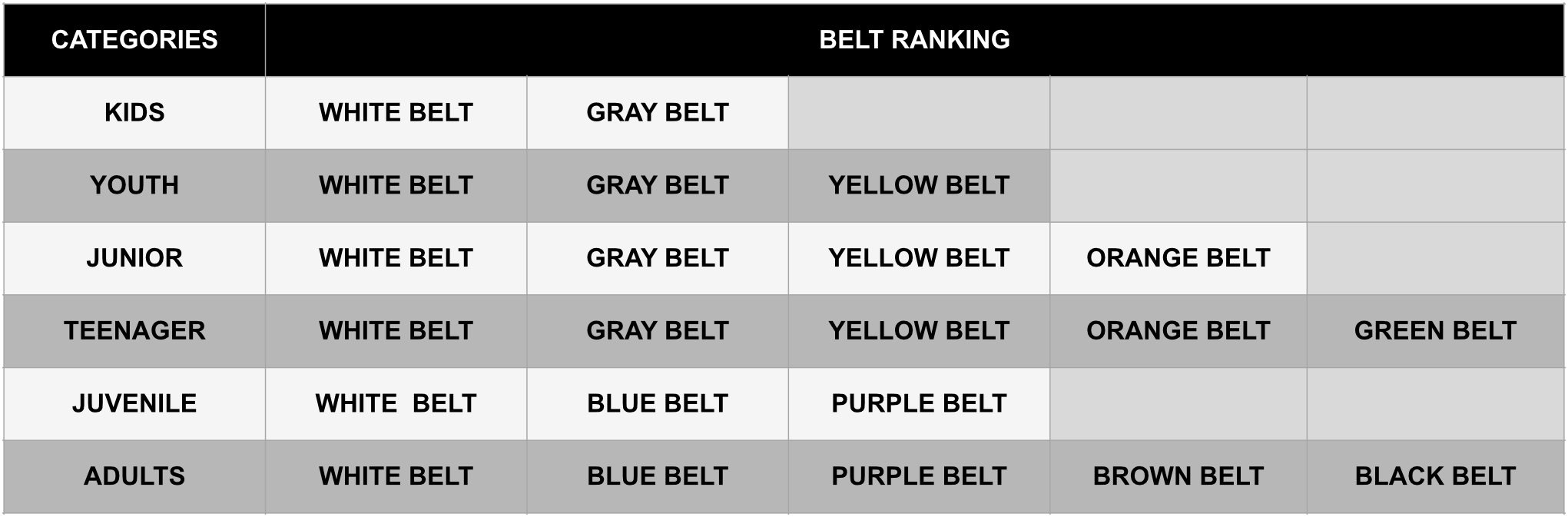
Separation by Experience Level
To ensure fairness and integrity in the competition, athletes will also be separated by experience level. For this event, the experience level will be determined by the athlete’s belt color.
Separation by weight division & Match duration


